Facts checked Article
Casino regulatory sources
Financial vulnerability checks and financial risk assessments run on different timetables
The £150 rolling threshold is an existing public-record check. The July 2026 financial-risk decision describes a separate staged programme whose first start date still needs confirmation in the sources reviewed.
Identify the check before interpreting the number
A financial vulnerability check and a financial risk assessment are different measures in Great Britain's gambling framework. The first already has an in-force rule based on deposits minus withdrawals exceeding £150 in a rolling 30-day period. The second was the subject of a staged-implementation decision announced on 7 July 2026.
A number from one cannot safely be used to describe the other.
Our source cut-off is 19 September 2026. The July announcement says the stage-one timetable will be confirmed following further engagement. The accompanying blog says the start date will be confirmed in a formal consultation response.
We did not establish a later confirmed commencement date in this research pass, so this article does not label the July thresholds as generally in force.
This distinction matters when an online-casino customer receives an explanation containing the loose phrase affordability check. That phrase alone does not identify the rule, threshold, data or timetable involved. A useful account starts by naming the mechanism.
The table and worked record below make those fields explicit; neither predicts what an individual operator will decide.
Sources: 3.4.4 – Financial vulnerability check; Commission to introduce Financial Risk Assessments in staged approach.
Register as of 19 September 2026 — two measures, two timetables
- Financial vulnerability check — in force
- Social responsibility code 3.4.4. Since 28 February 2025 the trigger is deposits minus withdrawals exceeding £150 in a rolling 30-day period, subject to the code's prior-check exception.3.4.4 – Financial vulnerability check · as checked on
- Financial vulnerability check — announced
- The two-stage introduction was announced on 1 May 2024. The initial threshold was more than £500 from 30 August 2024; the current code specifies that earlier interval as ending on 27 February 2025.New rules boosting safety and consumer choice · as checked on
- Financial risk assessments — decision
- A staged-implementation decision announced on 7 July 2026. The announcement says the stage-one timetable will be confirmed following further engagement.Commission to introduce Financial Risk Assessments in staged approach · as checked on
- Financial risk assessments — in force
- Not yet set. This research pass did not establish a later confirmed commencement date, so the July thresholds are not labelled as generally in force here.Commission to introduce Financial Risk Assessments in staged approach · as checked on
- Scope
- Requirements for the relevant licensed business in Great Britain, not a personal spending allowance. A number from one measure cannot safely be used to describe the other.3.4.4 – Financial vulnerability check · as checked on
Announced, in force and scope for each measure, from the Commission's own documents. Neither entry predicts what an individual operator will decide.
The existing rule uses public-record information
Social responsibility code 3.4.4 requires a financial vulnerability check at the relevant threshold for licences within its stated scope. Its minimum is a customer-specific public-record check for significant indicators of possible financial vulnerability, including bankruptcy and specified debt-related records.
The business must consider that information alongside other information it can use, take proportionate action where risk is identified and record its reasoning. The code also addresses automated decisions and manual review. The threshold does not itself prescribe one automatic outcome for every customer.
Since 28 February 2025 the trigger is deposits minus withdrawals exceeding £150 in a rolling 30-day period. A check is not required at that point under this provision if the operator has already conducted a financial vulnerability check or financial risk assessment within the previous 12 months. That exception should travel with any simplified account of the trigger.
These are requirements for the relevant licensed business, not a personal spending allowance. A customer cannot infer that an amount below the threshold is affordable or that no other obligation can lead to an interaction. The published condition answers a defined regulatory question, not a complete assessment of somebody's circumstances.
Sources: 3.4.4 – Financial vulnerability check.
Read the earlier £500 figure with its end date
The Commission announced the two-stage vulnerability-check introduction on 1 May 2024. The initial threshold was more than £500, with implementation from 30 August 2024. The lower threshold followed on 28 February 2025.
The current code specifies the earlier interval as ending on 27 February 2025.
An older page quoting £500 can therefore be historically accurate while being unsuitable as a description of the present trigger. Preserve its document date and the period it describes. Replacing £500 with £150 inside an archived quotation would erase the history rather than explain the change.
The 2024 announcement also discussed a pilot of financial risk assessments. That parallel discussion is one source of confusion: a single news release addressed an implemented check and work on a separate assessment. Reading one paragraph without its heading can merge them into a rule that the document never stated.
Our comparison method gives every entry five fields: measure, source date, status, threshold and unresolved next step. A historical threshold belongs in the record with its end date. It should not compete with the current figure as though readers merely need to choose the smaller number.
Sources: New rules boosting safety and consumer choice; 3.4.4 – Financial vulnerability check.
Five fields for every change-register entry
A historical threshold belongs in the record with its end date. It should not compete with the current figure as though readers merely need to choose the smaller number.
Ticks are kept only in this browser and are never sent anywhere.
July 2026 brought a staged decision, not one universal start
For the first stage, the July announcement describes implementation by the largest operators. Its table gives more than £5,000 in net deposits over a rolling 24 hours for consumers aged 25 and over, and more than £2,500 for high-risk groups such as those under 25. The wording of that second column is broader than age alone.
The same table describes a final stage: above £1,000 over 24 hours or £3,000 over 90 days for those aged 25 and over; above £750 over 24 hours or £2,000 over 90 days for the other column. Intermediate stages remain to be set after further engagement. These are distinct planned stages, not competing estimates of one threshold.
The announcement leaves the first timetable to a later confirmation. A careful summary therefore keeps decision date separate from commencement. The final-stage figures are not a shortcut for deciding which check an account should receive today.
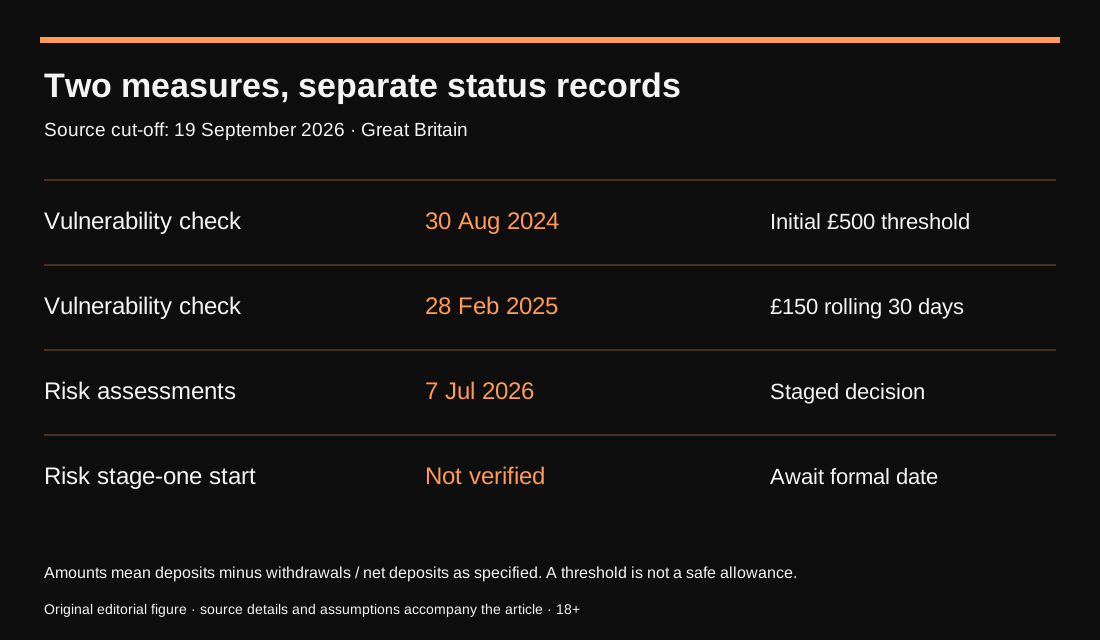
Our figure uses a solid label for the existing vulnerability rule and a clearly marked date-pending label for the staged programme. It does not draw a completed timeline into the future. An empty commencement field is more informative than an invented date.
| Measure | Document or effective date | Status or threshold |
|---|---|---|
| Vulnerability check | 30 Aug 2024 | Initial £500 threshold |
| Vulnerability check | 28 Feb 2025 | £150 rolling 30 days |
| Risk assessments | 7 Jul 2026 | Staged decision |
| Risk stage-one start | Not verified | Await formal date |
Sources: Commission to introduce Financial Risk Assessments in staged approach.
Financial risk assessments — staged thresholds as announced
| Stage | Consumers aged 25 and over | High-risk groups, such as those under 25 | Start date | Evidence |
|---|---|---|---|---|
| First stage (largest operators) | More than £5,000 in net deposits over a rolling 24 hours | More than £2,500 in net deposits over a rolling 24 hours | To be confirmed following further engagement | · Commission to introduce Financial Risk Assessments in staged approach |
| Intermediate stages | Remain to be set after further engagement | Remain to be set after further engagement | Not set | · Commission to introduce Financial Risk Assessments in staged approach |
| Final stage | Above £1,000 over 24 hours or £3,000 over 90 days | Above £750 over 24 hours or £2,000 over 90 days | Not set | · Commission to introduce Financial Risk Assessments in staged approach |
The wording of the second column is broader than age alone. These are distinct planned stages, not competing estimates of one threshold, and not a shortcut for deciding which check an account should receive today.
Work an existing threshold without turning it into advice
Take an invented rolling 30-day record containing £220 in deposits and £70 in withdrawals. The difference is £150. The code says exceeds £150, so equality alone does not cross that numerical threshold.
Change the fictional deposits to £221 while keeping withdrawals at £70 and the difference becomes £151, which exceeds it. This isolates the wording; it is not an account test or guidance on avoiding checks.
The example still needs the rule's other conditions. Which licensed business holds the account? Which transactions fall within the rolling period?
Has a qualifying check already occurred within the previous 12 months? A subtraction cannot answer those questions by itself.
Nor is the result necessarily the customer's gambling loss. Deposits and withdrawals are account cash movements. Stakes, returns and an existing balance are different entries.
We have not reconstructed them, so calling £151 a measured loss would add information that the record does not contain.
Finally, rolling 30 days is not a calendar month. As the observation time moves, earlier transactions can leave the period. A screenshot of this month's deposits without dated transactions may be insufficient to reproduce the threshold calculation.
Keep the original timestamps rather than replacing the period with a convenient monthly heading.
Sources: 3.4.4 – Financial vulnerability check.
Financial vulnerability check — the £150 wording, worked
An invented rolling 30-day record. The exercise isolates the code's wording; it is not an account test or guidance on avoiding checks.
Take the invented record
£220 in deposits and £70 in withdrawals within the rolling 30-day period. The difference is £150.
Compare with the code's wording
The code says exceeds £150, so equality alone does not cross that numerical threshold.
Change one figure
Change the fictional deposits to £221 while keeping withdrawals at £70. The difference becomes £151, which exceeds it.
Add the rule's other conditions
Which licensed business holds the account? Which transactions fall within the rolling period? Has a qualifying check already occurred within the previous 12 months? A subtraction cannot answer those questions by itself.
What the result means
Only the wording has been isolated. The difference is not necessarily the customer's gambling loss, rolling 30 days is not a calendar month, and a screenshot without dated transactions may not reproduce the calculation.
Document-free does not mean every process needs no documents
The July explanatory blog describes credit-reference information as the basis of financial risk assessments and says the assessments will not affect customers' credit ratings. It also describes a small group for whom a frictionless assessment may not be possible, including cases where identity needs to be verified properly. Other means may then include open banking or document requests.
That is a narrower claim than nobody will ever be asked for financial documents. It also does not say that every document request is a financial risk assessment. Customer interaction and identity or anti-money-laundering processes can involve different questions.
This briefing does not prescribe a KYC upload pack or judge a particular request.
Keep an operator's explanation attached to the process it actually names. If a message says only verification, ask which check is meant and what point remains unresolved. A general news article cannot supply an account-specific reason that the message omitted.
The distinction also limits what this research can establish. We inspected public rules and explanations, not live credit-reference connections, account decisions or data-transfer logs. The Commission's policy description is evidence of its announced approach, not a measurement by this publication of operational performance.
A check result is not a one-number decision
The Commission describes financial risk assessments as part of a wider set of measures and says businesses should consider what else they know about a customer. Its July blog discusses proportionate support, including changes to marketing or help with limits. That does not create one publicly calculable decision rule for every account.
This matters when a threshold table is shared as though it were a list of automatic account closures, compulsory deposit limits or permissions to continue playing. Those outcomes are not the same as a trigger to obtain information. A sound summary separates the event that prompts a check from the response to what is learned.
The policy discussion also distinguishes the mechanics of obtaining information from the judgement needed afterwards. This article cannot infer that judgement from a fictional cash-flow record. It therefore reports no pass rate, account success story or promise that a particular balance will remain available.
Readers seeking a practical control need the operator's current controls and support information. Readers examining a document request need the actual request and its purpose. The task here is chronological: establish which public measure the explanation can reasonably refer to, and which parts still depend on implementation.
Sources: Financial risk assessments update – July 2026.
Terms used in this bulletin
- Financial vulnerability check
- The public-record check required by social responsibility code 3.4.4 at the £150 rolling 30-day trigger; the measure already in force.
- Financial risk assessment
- The separate staged programme announced on 7 July 2026, based on limited credit-reference information; its stage-one start is not yet confirmed in the sources reviewed.
- Affordability check
- A loose phrase that does not identify the rule, threshold, data or timetable involved. Ask which mechanism is meant.
- KYC
- Know-your-customer identity checks: a process with its own questions, distinct from either financial measure described here.
- Net deposits
- Deposits minus withdrawals over the stated period. Not the same as stakes, returns or a gambling loss.
- Commencement date
- The date from which a measure binds an operator. It is different from the announcement or decision date.
What would change this briefing
A confirmed stage-one commencement document would change the status entry. So would a revised threshold, a defined intermediate stage or a change to the applicable licence scope. Those developments need their own dated sources.
Repeating the July decision with a new retrieval date would not establish any of them.
Before publication or reliance on a later date, recheck the formal consultation response and current licence conditions. Keep the original announcement in the history, while identifying the newer document that changes the position. This briefing's unresolved start date is a limit of the verified source set, not a claim that no further document could exist.
The usable distinction remains straightforward: the existing £150 vulnerability check and the staged financial-risk programme have different source records. Attach the threshold, period, scope and status to the correct one. Neither figure is advice about how much to gamble, and neither removes the option to stop or seek support before a regulatory threshold is reached.
Sources: Financial risk assessments update – July 2026; Commission to introduce Financial Risk Assessments in staged approach.
What would change this briefing
Each development needs its own dated source. Repeating the July decision with a new retrieval date would not establish any of them.
Ticks are kept only in this browser and are never sent anywhere.
Questions answered
When does a rule announced today actually apply?
On the commencement date established by its governing document, which may differ from the announcement date. The July 2026 financial-risk decision leaves stage-one timing for later confirmation in the sources reviewed here.
What are the upcoming changes to gambling regulation in the UK?
For this specific Great Britain topic, the Commission has announced staged financial risk assessments. The future stages must be distinguished from the financial vulnerability rule already in force; this article is not a register of all UK changes.
How does a Financial Risk Assessment work?
The July blog describes limited credit-reference information used alongside other information about high-spending customers. It is separate from the existing public-record vulnerability check and does not prescribe one outcome for every account.
What is the timeline for implementation?
The July documents say the stage-one start will be confirmed following engagement, with the blog pointing to a formal consultation response. This research did not verify that later commencement document, so no start date is asserted.
Does crossing the £150 threshold mean I have lost £150?
No. Deposits and withdrawals are account cash movements; stakes, returns and an existing balance are different entries. The subtraction isolates the code's wording, not a measured loss.
Is the £500 figure still correct?
Only as history. The initial threshold was more than £500 from 30 August 2024; the current code specifies that interval as ending on 27 February 2025, and the £150 trigger has applied since 28 February 2025.
Will a financial risk assessment affect my credit rating?
The Commission's July blog says the assessments will not affect customers' credit ratings. It also describes a small group for whom a frictionless assessment may not be possible, where other means may include open banking or document requests.
Source directory
Continue reading
Affordability checks gambling: what changes, for whom, and from when
Register as of 21 September 2026. 'Affordability checks' is not a term in the Licence Conditions and Codes of Practice. The phrase covers two measures with different dates. The financial vulnerability check has been in force since 30 August 2024, at £150 net deposits in a rolling 30 days since 28 February 2025. Financial risk assessments were announced as a staged programme on 7 July 2026, with no Stage 1 start date yet published.
Read Affordability checks gambling: what changes, for whom, and from when
The gambling levy’s 1.1% rate is an operator calculation
The statutory levy changed how gambling-harm funding is collected. Its rate, revenue base, first-year adjustment and later scope correction need to stay attached to the dates.
Read The gambling levy’s 1.1% rate is an operator calculation
Which Gambling Act Review measures apply to UK players now, and which are still to come
A dated register of Gambling Act Review measures, tracing policy announcements to the rules that took effect and keeping proposals with no confirmed start date separate.
Read Which Gambling Act Review measures apply to UK players now, and which are still to come
Jurisdiction before the headline: what changes, for whom, and from when
A casino rule change is not a worldwide rule change. Section 33 of the Gambling Act 2005 states the position for Great Britain, and a licence issued elsewhere does not carry into it.
Read Jurisdiction before the headline: what changes, for whom, and from when
Two dates every regulatory summary needs
The day a change is announced and the day it takes effect can be months apart.
Read Two dates every regulatory summary needs
UK online casino regulation changes: how to read the dates and scope
Follow the online slots and bonus-rule timelines to distinguish a consultation, decision, implementation date and later correction.
Read UK online casino regulation changes: how to read the dates and scope
Continue reading
Affordability checks gambling: what changes, for whom, and from when
Register as of 21 September 2026. 'Affordability checks' is not a term in the Licence Conditions and Codes of Practice. The phrase covers two measures with different dates. The financial vulnerability check has been in force since 30 August 2024, at £150 net deposits in a rolling 30 days since 28 February 2025. Financial risk assessments were announced as a staged programme on 7 July 2026, with no Stage 1 start date yet published.
Read Affordability checks gambling: what changes, for whom, and from whenThe gambling levy’s 1.1% rate is an operator calculation
The statutory levy changed how gambling-harm funding is collected. Its rate, revenue base, first-year adjustment and later scope correction need to stay attached to the dates.
Read The gambling levy’s 1.1% rate is an operator calculationWhich Gambling Act Review measures apply to UK players now, and which are still to come
A dated register of Gambling Act Review measures, tracing policy announcements to the rules that took effect and keeping proposals with no confirmed start date separate.
Read Which Gambling Act Review measures apply to UK players now, and which are still to comeFind an official casino source
Jurisdiction before the headline: what changes, for whom, and from when
Two dates every regulatory summary needs
Which Gambling Act Review measures apply to UK players now, and which are still to come
Affordability checks gambling: what changes, for whom, and from when
The gambling levy’s 1.1% rate is an operator calculation
UK online casino regulation changes: how to read the dates and scope