Core guide
Which Gambling Act Review measures apply to UK players now, and which are still to come
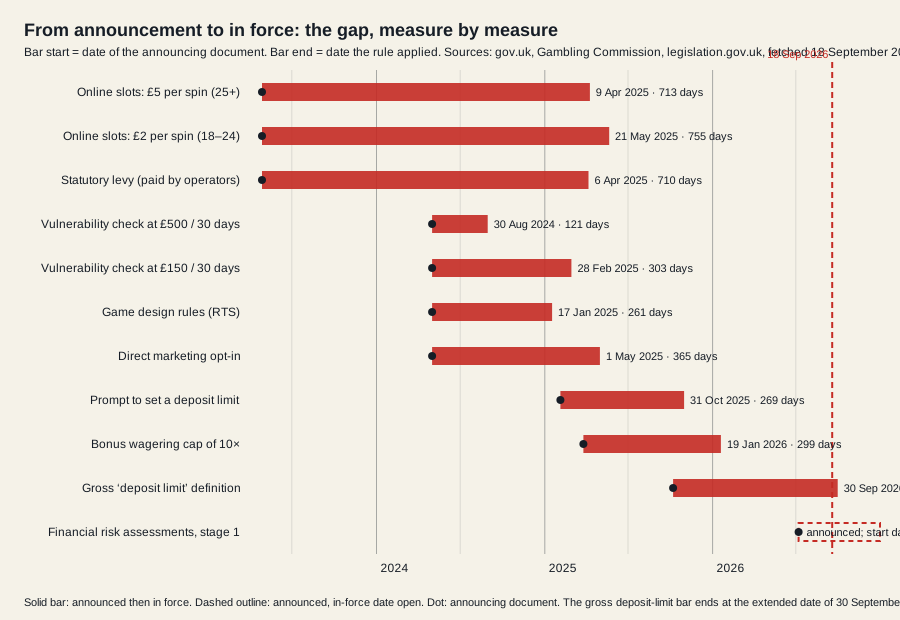
Eleven measures from the 2023 white paper, each traced to the document that announced it and the document that brought it into force, with the dates that are still open left open.
One white paper, three kinds of instrument, four dates each
The Department for Culture, Media and Sport published High stakes: gambling reform for the digital age on 27 April 2023. It is a policy document. Nothing in it changed a rule on the day it appeared. Its executive summary said the intention was that "the main measures in the white paper will be in force by summer 2024". On 19 September 2026, two of the measures it named are still not in force.
What the white paper set in motion was three separate legal routes, and a reader who wants to know whether a rule applies to them needs to know which route a measure took. Some measures needed regulations made by ministers and approved by both Houses: the online slot stake limit and the statutory levy are both statutory instruments dated 25 February 2025 on legislation.gov.uk. Some measures needed only a change to the Gambling Commission's Licence Conditions and Codes of Practice (LCCP) or its Remote Gambling and Software Technical Standards (RTS), which the Commission can amend after consultation without Parliament. Bonus rules, marketing opt-in, game design rules and deposit-limit tools all travelled that way. A third group, the ombudsman among them, has no instrument yet.
Each measure on that second route also generated four dates: the day the Commission opened a consultation, the day it closed, the day the Commission published its response with a decision, and the day the new wording took effect. The response and the effective date are routinely months apart. The bonus wagering cap was decided on 26 March 2025 and applied from 19 January 2026. This page treats only the last date as "in force". Our shorter note on the two dates every regulatory summary needs explains why that discipline matters; this page applies it across the whole review.
Scope is Great Britain. The Gambling Act 2005 does not extend to Northern Ireland, and none of the instruments below do either.
Sources: DCMS: High stakes: gambling reform for the digital age.
Slot stake limits: the measure that needed Parliament
The white paper proposed "a stake limit for online slots, consulting on a limit of between £2 and £15 per spin", with three options for 18 to 24 year olds: £2, £4 or "an approach based on individual risk". DCMS ran the consultation from 26 July to 4 October 2023 and published its outcome on 23 February 2024, choosing £5 per spin for adults aged 25 and over and £2 for adults aged 18 to 24. The outcome document gives no implementation date. It could not: the limit needed regulations.
Those regulations are the Gambling Act 2005 (Operating Licence Conditions) (Amendment) Regulations 2025, SI 2025/215, made on 25 February 2025. Regulation 1(2) says they "come into force six weeks after the day on which they are made", which is 9 April 2025. The operative wording attaches a condition to remote casino operating licences: for an individual under 25, "the total amount which an individual may stake in relation to any game cycle may not exceed £2"; for an individual aged 25 or over, "may not exceed £5". A transitional provision applies the £5 figure to everyone for a further six weeks, which is how the Commission's guidance arrives at two dates: the £5 limit from 9 April 2025 and the £2 limit for under-25s from 21 May 2025.
Three things about scope are stated in the primary sources and are worth carrying whole. The unit is the game cycle, which is a per-spin ceiling, not a session or daily cap. The product is online slots: the Commission's guidance says the limits "do not apply to other casino games, such as roulette or blackjack". And the licence type is a remote casino operating licence issued in Great Britain, so an operator licensed elsewhere is outside the rule entirely, whatever its site looks like. Where a game is based, and under which licence, is a question Night Atlas's work on online casino jurisdictions handles in the long form.
Sources: DCMS: A maximum stake limit for online slots games in Great Britain; SI 2025/215; Gambling Commission: Online slots stake limit guidance.
Financial checks: the one that exists and the one that does not yet
The word "affordability checks" covers two different measures, and the confusion between them is the single most common error in coverage of the review. The white paper proposed two tiers. The first was "background checks at moderate levels of spend" triggered "at £125 net loss within a month or £500 within a year". The second was an "enhanced" assessment at "£1,000 net loss within 24 hours or £2,000 within 90 days". Only a version of the first tier is in force.
The in-force measure is LCCP social responsibility code 3.4.4, the financial vulnerability check. It applies to remote licences. From 30 August 2024 to 27 February 2025 it was triggered when a customer's "deposits minus withdrawals exceeds £500 in a rolling 30-day period"; from 28 February 2025 the figure is £150. The check is "a customer-specific public record information check for significant indicators of potential financial vulnerability": bankruptcy orders, county court judgments, individual voluntary arrangements, debt relief orders and similar. It is not a request for payslips or bank statements, and the Commission's 1 May 2024 announcement said it would use "publicly available data" and would not use the customer's postcode or job title. Note that the trigger is net deposits, not net loss as the white paper had framed it.
The second tier, the financial risk assessment, went into a pilot instead of into force. The Commission's response of 1 May 2024 said it was "not being rolled out in a live environment". A progress update on 10 February 2025 reported that stage 1 had run over 530,000 assessments across three credit reference agencies for roughly 300,000 accounts, with "approximately 95 percent of assessments were matched". The LCCP record shows a "financial risk assessment pilot analysis phase" for remote operators taking effect on 7 August 2025.
Then, on 7 July 2026, the Commission announced that financial risk assessments would be introduced "in a staged approach". Stage 1 thresholds are £5,000 net deposit in a rolling 24 hours for customers aged 25 and over and £2,500 for those under 25. The final thresholds are £1,000 in 24 hours or £3,000 in 90 days for over-25s, and £750 in 24 hours or £2,000 in 90 days for under-25s. Implementation is to begin in "summer 2026" with the stage 1 timetable "to be confirmed" after stakeholder engagement, and the intermediate thresholds "to be set following further engagement". The announcement reports that in the pilot "97 percent of those spending above the threshold levels could be easily and frictionlessly assessed", against the white paper's estimate of 80 percent. On 19 September 2026 no LCCP condition carrying these thresholds has an effective date. The register below marks the in-force date as open, because it is.
Sources: LCCP SR code 3.4.4; Gambling Commission: New rules boosting safety and consumer choice; Pilot progress update; Staged approach announcement.
The levy moves money between operators and the state
The white paper said "Government will introduce a statutory levy paid by operators and collected and distributed by the Gambling Commission under the direction and approval of Treasury and DCMS ministers." DCMS consulted from 17 October to 14 December 2023 and published its response on 27 November 2024. The Gambling Levy Regulations 2025, SI 2025/213, were made on 25 February 2025 and came into force on 6 April 2025.
The rate depends on licence type. Remote casino, remote bingo, remote general betting, remote betting intermediary and gambling software licences pay 1.1%; non-remote casinos and betting shops 0.5%; adult gaming centres, non-remote bingo and on-course betting 0.2%; family entertainment centres, lotteries, pool betting and machine technical licences 0.1%. The base is the leviable amount, defined in the regulations as stakes and other amounts paid to the licensee during the levy period "minus the aggregate of amounts deducted during the levy period ... for the provision of prizes or winnings", which is gross gambling yield in plainer words. The government's response put the expected total at "approximately £90-£100 million" a year, split 50% to treatment through NHS England and the Scottish and Welsh equivalents, 30% to prevention, and 20% to research through UK Research and Innovation and the Commission.
For a player the levy changes nothing at the point of play. It is a charge on the operator, calculated on the operator's yield. What it replaced is worth recording: the LCCP requirement that operators make annual voluntary contributions to research, education and treatment bodies was removed on 1 April 2025, five days before the levy took effect. The first levy period for most licences was "the period of 9 months beginning with 1st July 2024", with payment due "before the 1st October following the end of that levy period", so the first payments fell due before 1 October 2025.
Sources: SI 2025/213; DCMS: Government response on the statutory levy; LCCP previous changes.
Bonuses and marketing: the 10× cap and the opt-in
The white paper asked the Commission to "review the design and targeting of incentives such as free bets and bonuses to ensure there are clear rules and fair limits on re-wagering requirements and time limits". The Commission's autumn 2023 consultation on socially responsible incentives closed on 21 February 2024; the response was published on 26 March 2025. It chose a cap over a ban. The Commission's reasoning was that a ban would push operators towards "terms and conditions that prevent customers from cashing out bonuses" and could push customers "to seek higher value offers in the online illegal market", and that there was "limited evidence to justify 5 times over the 10 times wagering requirement". The response notes that some operators "currently apply up to 60 times wagering requirements".
The result is the current LCCP social responsibility code 5.1.1. Licensees must not "apply wagering requirements, which requires a customer to play through bonus funds, over a maximum of 10 times", and must not "include more than one type of gambling product (betting, casino, bingo, and lottery) within an incentive". It applies to all licences except gaming machine technical and gambling software licences. The effective date was first published as 19 December 2025. The Commission's news page carries an update note: "The date for implementation has been changed from 19 December 2025 to 19 January 2026." The LCCP change log confirms 19 January 2026. A summary written from the March 2025 announcement and never revisited will carry the wrong date. How a wagering requirement is calculated, and what a 10× term means for a given bonus, is the subject Terms in Plain Sight covers; this page records only the rule and its date.
Direct marketing took the other route in the same review. The white paper wanted customers "opting-in for online bonuses and offers for different types of gambling products". The Commission's summer 2023 consultation response on 1 May 2024 confirmed the change with an effective date of 1 May 2025. LCCP code 5.1.12 now requires remote casino, bingo and betting licensees to let customers opt in by product, "betting, casino, bingo, as applicable", and by channel, "phone call, email and text messages (SMS) as applicable". Existing customers who had not already opted out had to be asked "at their first log-in after commencement". A customer who has not opted in to a product and a channel should not be receiving that marketing; one who has opted in will keep receiving it until they change the setting.
Sources: Consultation response: wagering requirements; LCCP SR code 5.1.1; Gambling promotions to be safer and simpler; LCCP code 5.1.12.
Inside the game screen: design rules and deposit-limit tools
The white paper committed to "review and consult on updating design rules for online products", naming "speed of play, illusion of player control and other intensifying features". The Commission had already applied such rules to online slots in 2021. The summer 2023 consultation extended them to other casino games, and the RTS changes took effect on 17 January 2025. From that date operators cannot offer features that "speed up the time for a result to be shown or can give the illusion of control", such as "turbo" or "slam stops" (RTS 14E); autoplay is restricted (RTS 8A); "celebrations of returns less than or equal to stake" are restricted (RTS 14F); operator-led functionality for "playing multiple simultaneous products" is controlled (RTS 14C); net spend and net time must be displayed (RTS 2E and 13C); and there is "a minimum spin speed for casino games of 5 seconds (excluding peer-to-peer poker)" (RTS 14G).
Deposit limits arrived in two phases. The autumn 2023 consultation response of 4 February 2025 required operators, from 31 October 2025, to "prompt their customers to set a financial limit before they make their first deposit", to "remind consumers every six months to review their account and transaction information", and to make the limit "easy to review and alter". A separate disclosure rule from the same date requires operators holding unprotected customer funds to "actively remind consumers once every six months that their funds are not protected" in an insolvency.
The second phase fixes what the words "deposit limit" mean. The Commission's response of 7 October 2025 requires a deposit limit to be "based solely on the amount a customer pays into their account over a set duration", that is, a gross figure, not deposits net of withdrawals. The original effective date was 30 June 2026. On 26 May 2026 the Commission extended it to 30 September 2026 "to allow for further operator technical development time". On 19 September 2026 that date has not arrived, so the register lists the phase as announced, with an in-force date twelve days away. What a player can do with these tools once they exist, and how they interact with time-outs and self-exclusion, is Play in Balance's territory.
Sources: Updates to RTS effective 17 January 2025; New rules empowering consumers and boosting operator transparency; New deposit limit rules provide clarity for consumers; Implementation extension.
The change register
Every row below was checked against the source in its "Source document" column on 19 September 2026. "Announced" is the publication date of the document that stated the decision, not the consultation that preceded it. "In force" is the date the instrument, condition or standard took effect, as that instrument states it. "Open" means no primary source gives a date. A measure is marked in force only where the effective date has passed.
| Measure | Source document | Announced | In force | Status | Scope |
|---|---|---|---|---|---|
| Online slot stake limit, £5 per game cycle, age 25+ | SI 2025/215, reg 5(2)(b); DCMS consultation outcome | 23 Feb 2024 (DCMS outcome); SI made 25 Feb 2025 | 9 Apr 2025 | In force | Remote casino operating licences; online slots only; per game cycle |
| Online slot stake limit, £2 per game cycle, age 18–24 | SI 2025/215, reg 5(2)(a) and transitional provision | 23 Feb 2024; SI made 25 Feb 2025 | 21 May 2025 | In force | As above; individuals under 25 |
| Financial vulnerability check, £500 net deposits in rolling 30 days | LCCP SR 3.4.4, para 7 | 1 May 2024 | 30 Aug 2024 to 27 Feb 2025 | Superseded | Remote licences; public-record check only |
| Financial vulnerability check, £150 net deposits in rolling 30 days | LCCP SR 3.4.4 | 1 May 2024 | 28 Feb 2025 | In force | Remote licences; public-record check only |
| Financial risk assessment, stage 1: £5,000 (25+) or £2,500 (under 25) net deposits in 24 hours | Commission announcement, 7 Jul 2026 | 7 Jul 2026 | Open (from "summer 2026", timetable to be confirmed) | Announced | Remote licences; credit reference agency data, no documents |
| Financial risk assessment, final thresholds: £1,000/24h or £3,000/90d (25+); £750/24h or £2,000/90d (under 25) | As above | 7 Jul 2026 | Open (intermediate stages "to be set") | Announced | As above |
| Statutory levy, 1.1% of leviable amount for remote licences (0.5%, 0.2%, 0.1% for other types) | SI 2025/213; DCMS response 27 Nov 2024 | 27 Nov 2024; SI made 25 Feb 2025 | 6 Apr 2025 (first payments due before 1 Oct 2025) | In force | All operating licences; paid by operators, not players |
| Bonus wagering requirements capped at 10×; mixed-product incentives banned | LCCP SR 5.1.1; consultation response 26 Mar 2025 | 26 Mar 2025 (date first given as 19 Dec 2025) | 19 Jan 2026 | In force | All licences except gaming machine technical and software |
| Direct marketing opt-in by product and by channel | LCCP 5.1.12; consultation response 1 May 2024 | 1 May 2024 | 1 May 2025 | In force | Remote casino, bingo and betting licences |
| Game design: no turbo or slam stop, autoplay restricted, 5-second minimum spin, net spend and time displayed | RTS 2E, 8A, 13C, 14C, 14E, 14F, 14G | 1 May 2024 | 17 Jan 2025 | In force | Remote casino games; peer-to-peer poker excluded from spin speed |
| Prompt to set a financial limit before first deposit; six-monthly review reminder; unprotected-funds reminder | Consultation response 4 Feb 2025; RTS 12; LCCP change log | 4 Feb 2025 | 31 Oct 2025 | In force | Remote licences |
| "Deposit limit" must mean gross deposits over a fixed period | Extension notice 26 May 2026; response 7 Oct 2025; RTS 12 | 7 Oct 2025 (date first given as 30 Jun 2026) | 30 Sep 2026 | Announced; not yet in force | Remote licences |
| Voluntary research, education and treatment contribution requirement removed | LCCP change log | 4 Feb 2025 | 1 Apr 2025 | In force | All licences; replaced by the levy |
| Gambling ombudsman | White paper, chapter 4 | 27 Apr 2023 (as an intention) | Open | Proposed; no instrument found | Complaints about social responsibility or gambling harm |
| Gambling Commission licence fees rise 25% overall | DCMS response, reported 30 Jun 2026 | 30 Jun 2026 | 1 Oct 2026, "subject to the passage of secondary legislation" | Announced; not yet in force | Operators; no direct player-facing rule |
Two dates in the register differ by a day between Commission pages. The Personal Management Licence change, which is not player-facing and is not in the table, is dated 30 November 2024 in the Commission's news release and 29 November 2024 in its LCCP change log. Where a similar discrepancy affects a row above, the date in the instrument itself is used and the news date is treated as secondary.
What the white paper promised that has not arrived
Three commitments in the white paper have no effective date in any primary source fetched for this page. The ombudsman, described as "fully operationally independent" and meant to "adjudicate complaints relating to social responsibility or gambling harm", has no founding instrument on gov.uk or the Commission's site as at 19 September 2026. A cross-operator data-sharing system for harm prevention, which the white paper said it would consider "mandating" after a trial, has no rule attached to it. And the enhanced financial risk assessment, the measure most often called an "affordability check" in press coverage, has thresholds published but no start date.
Two proposals were changed on the way through. The white paper's first-tier check was framed as net loss, "£125 net loss within a month or £500 within a year"; the rule in force is framed as net deposits, £150 in a rolling 30 days, with the £500 figure having served as an interim threshold for six months. The white paper's top-tier thresholds of £1,000 in 24 hours or £2,000 in 90 days survive only for under-25s in the 7 July 2026 announcement's 90-day figure; for over-25s the 90-day figure is now £3,000. Those are not errors in the white paper. They are what consultation is for, and a reader quoting the 2023 numbers as current is quoting a proposal.
One measure has gone the other way and arrived without appearing in the white paper's headline list: the gross definition of a deposit limit, which came out of a supplementary consultation in 2025 once the Commission found operators labelling net-of-withdrawal limits as "deposit limits".
Sources: DCMS white paper; Staged approach announcement; Deposit limit definition.
How to read a date, and how this register was built
The method is repeatable with a browser. For each measure, find the document that states the decision, not the one that proposed it: for a statutory instrument that is the "made" text on legislation.gov.uk, and for an LCCP or RTS change it is the Commission's consultation response. Take the effective date from the instrument or from the LCCP change log, not from a news article, because news pages are edited after publication; the bonus-cap page carries an update note for exactly that reason. Record the licence type the rule attaches to, the product it names, and the unit it uses. Then compare the effective date with today's date. If today is earlier, the rule is announced. If a source says "to be confirmed", the date is open, and no amount of reporting turns it into a date.
Applied to the question of when a rule announced today applies, the register gives a working range rather than a promise. The Commission's own LCCP and RTS changes clustered between 261 and 365 days from response to effective date; measures needing regulations took close to two years from the white paper. The honest answer until the Commission publishes a date, though, is that a measure does not yet apply at all.
Limits of the register. It covers measures that change what an online casino or betting operator licensed in Great Britain must do towards a customer. It leaves out land-based measures beyond the age verification test-purchasing rule that took effect on 30 August 2024, and it leaves out the Commission's internal changes to regulatory panels and Personal Management Licences. It does not assess whether any operator complies. It will be corrected when a source above changes; the "Sources checked" date at the top of the page is the date to trust.
Sources: LCCP previous changes; Gambling promotions to be safer and simpler.
Sources
- High stakes: gambling reform for the digital age, Department for Culture, Media and Sport, retrieved 19 September 2026.
- Major reform of gambling laws to protect vulnerable users in smartphone era, Department for Culture, Media and Sport, retrieved 19 September 2026.
- A maximum stake limit for online slots games in Great Britain, Department for Culture, Media and Sport, retrieved 19 September 2026.
- The Gambling Act 2005 (Operating Licence Conditions) (Amendment) Regulations 2025, SI 2025/215, legislation.gov.uk, retrieved 19 September 2026.
- Online slots stake limit guidance, Gambling Commission, retrieved 19 September 2026.
- The Gambling Levy Regulations 2025, SI 2025/213, legislation.gov.uk, retrieved 19 September 2026.
- Government response to the consultation on the structure, distribution and governance of the statutory levy on gambling operators, Department for Culture, Media and Sport, retrieved 19 September 2026.
- Statutory levy and online slot stake limits to be introduced to tackle gambling harm, Department for Culture, Media and Sport, retrieved 19 September 2026.
- New rules boosting safety and consumer choice, Gambling Commission, retrieved 19 September 2026.
- LCCP Condition 3.4.4: Financial vulnerability check, Gambling Commission, retrieved 19 September 2026.
- Commission updates on progress of the financial risk assessments pilot, Gambling Commission, retrieved 19 September 2026.
- Commission to introduce Financial Risk Assessments in staged approach, Gambling Commission, retrieved 19 September 2026.
- Updates to RTS effective 17 January 2025, Gambling Commission, retrieved 19 September 2026.
- LCCP Condition 5.1.12: Direct marketing preferences, Gambling Commission, retrieved 19 September 2026.
- Autumn 2023 consultation response: Proposal 1, ban or limit the use of wagering requirements, Gambling Commission, retrieved 19 September 2026.
- LCCP Condition 5.1.1: Rewards and bonuses, Gambling Commission, retrieved 19 September 2026.
- Gambling promotions to be safer and simpler, Gambling Commission, retrieved 19 September 2026.
- New rules empowering consumers and boosting operator transparency, Gambling Commission, retrieved 19 September 2026.
- New deposit limit rules provide clarity for consumers, Gambling Commission, retrieved 19 September 2026.
- Implementation extension for new deposit limit requirements, Gambling Commission, retrieved 19 September 2026.
- LCCP previous changes, Gambling Commission, retrieved 19 September 2026.
- Consultations, Gambling Commission, retrieved 19 September 2026.
- DCMS concludes consultation on gambling regulation funding, Gambling Commission, retrieved 19 September 2026.
- BIM22015: Meaning of trade: exceptions and alternatives: betting and gambling, HM Revenue & Customs, retrieved 19 September 2026.