Core guide
UK online casino regulation changes: how to read the dates and scope
Follow the online slots and bonus-rule timelines to distinguish a consultation, decision, implementation date and later correction.
Ask whether the story describes a plan or an applicable rule
A headline saying casino rules are changing can refer to a consultation, a decision, a future implementation date or a rule already in effect. Those stages should not be collapsed into one statement that something is now required. The date on the article is only the first clue.
Casino Signal reads a regulatory story through four questions: who issued it, what action the document records, which products and people it concerns, and when that action applies. Our note on announcement and effective dates introduces the distinction; this guide develops it through two real online-casino timelines.
The worked examples concern Great Britain and use primary government or Gambling Commission documents. They do not assess an individual operator’s compliance or supply legal advice about a specific account. A rule can be in force while a particular factual question still needs the actual game, terms and relevant circumstances.
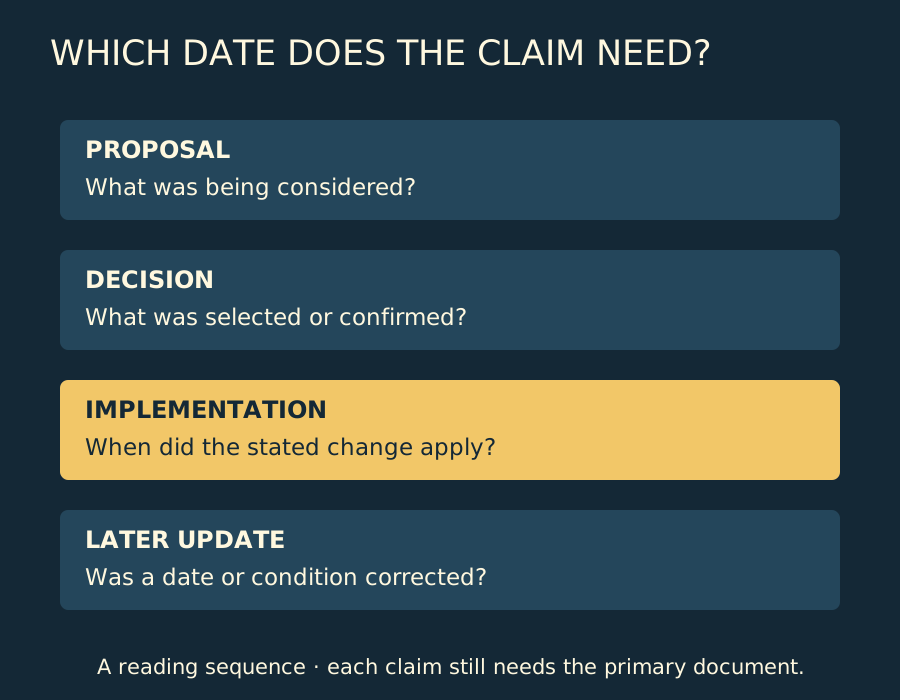
Begin with the verb. Consults, proposes, confirms, introduces and updates describe different actions. Read the supporting paragraph to see what the source actually did rather than let a shortened headline determine the interpretation.
The slots consultation did not itself establish the later start date
The DCMS consultation page records a public consultation running from 26 July to 4 October 2023 and an outcome published on 23 February 2024. The proposal stage considered possible limits; the outcome identified the selected approach. Neither date should be casually substituted for the later implementation dates.
A reader comparing an old news report with a current rules guide should therefore ask which stage the older report described. An article accurately reporting a proposal in 2023 can become misleading if its headline is reused as though it states the final rule in 2026.
Retain the document type beside the date in a timeline. “Consultation opened” and “consultation outcome published” are more precise than two entries both labelled rule change. The labels tell the reader what evidence the event supplies.
Consultation responses also need scope. They can explain the government’s reasoning and selected policy, but implementation may require another instrument or later guidance. A complete chronology follows the relevant source trail rather than stopping at the earliest announcement that contains the same headline number.
Sources: DCMS: Maximum stake limit for online slots consultation outcome.
The slots guidance identifies two implementation milestones
The Gambling Commission’s online slots guidance states that the £5 limit for all adults went live on 9 April 2025 and the £2 limit for adults aged 18–24 went live on 21 May 2025. Its current explanation gives £5 for people aged 25 and over and £2 for those aged 18–24.
The order matters. A statement about a date between those milestones needs to account for the transition rather than apply the later age-specific condition retrospectively without explanation. The original milestone reader lets you inspect that order using a selected historical date.
The guidance also identifies the scope as online slots and explains that these limits do not apply to other casino games such as roulette or blackjack. Rewriting the headline as a universal £5 maximum for every online casino wager would therefore extend the claim beyond the source.
Keep the unit as well: the guidance concerns the relevant game cycle, not a daily budget or a guaranteed maximum total loss. A per-cycle ceiling does not prevent cumulative losses over multiple cycles. That difference should remain visible whenever a news summary translates a technical rule into plain language.
Sources: UK Gambling Commission: Online slots stake limit guidance.
A calendar date can be right while the sentence is wrong
Suppose an invented news summary says “On 21 May, every casino game became subject to the new lower limit.” It contains a real date from the slots timeline but describes the wrong breadth of product and audience. Checking only the date would not catch the error.
Another summary might correctly name online slots but omit the age group. A third might describe the limit as a daily cap. Each has preserved one element while changing another. This is why a good fact record keeps date, audience, product and unit together.
Use a short reconstruction exercise. Write the claim as “From this date, this condition applies to this product for this group, measured in this way.” Then compare every part with the primary source. If one part is missing, leave it missing until the source clarifies it.
The same method works for a rule affecting a casino brand. An announcement naming one licensed business does not automatically apply to every company using a similar trading name or every market where the brand appears. Scope is part of the fact, not an optional footnote.
The bonus timeline includes a corrected implementation date
The Gambling Commission’s bonus-change announcement was published on 26 March 2025. Its update note records a change from an earlier implementation date of 19 December 2025 to 19 January 2026. The announcement describes the maximum ten-times bonus wagering requirement and a ban on mixed-product promotional conditions.
This gives a concrete example of why a preserved early article can contain a superseded date even when its source was official. The correction does not mean the original report was fabricated. It means the record changed and a current summary needs to account for that update.
When maintaining a timeline, retain the original publication date, the update date and the final stated implementation date as separate fields. Replacing all three with “updated 2026” would erase the explanation of why two older sources disagree.
An accurate current statement can acknowledge the corrected date without reproducing a long history in every paragraph. The important point is to prevent the superseded date from remaining in an answer box, comparison table or headline after the body has been corrected.
Sources: UK Gambling Commission: Gambling promotions to be safer and simpler.
Choose a historical date to see which of three documented online-casino milestones had been reached.
Do not infer compliance or effectiveness from implementation
A rule’s implementation date identifies when the requirement applies under its stated scope. It does not, by itself, prove that every operator complied on that date. Nor does it measure the policy’s effect on behaviour or harm. Those are separate research questions.
For compliance, the relevant evidence might concern a named operator, product, transaction or regulator action. For effectiveness, an analysis would need an appropriate dataset, comparable periods and a method that accounts for other changes. A simple before-and-after percentage is not automatically a causal evaluation.
Consider an invented dataset that changes its operator coverage in the same month as a policy starts. A higher total afterwards could reflect the additional coverage. Without separating those factors, attributing the whole movement to the rule would go beyond the evidence.
This distinction helps readers interpret branded news as well. A company announcement that it has updated a feature is evidence of the company’s statement. Independent observation or a regulator finding is a different kind of evidence. Label them accordingly instead of merging them into one unqualified assertion.
Jurisdiction belongs near the beginning of the explanation
Our jurisdiction-before-headline note addresses the geographic question directly. A story can be published by a UK-based organisation while discussing another market. A gambling business can also operate across several markets with different entities and conditions.
Read the source’s named territory rather than infer it from the language, currency or the brand’s familiarity. Great Britain, the United Kingdom and an individual overseas jurisdiction should not be treated as interchangeable labels where the rule’s legal scope matters.
For a practical record, put territory beside product and audience. If an announcement concerns only one licence type or a defined group of customers, preserve that qualification in the summary. It may be the difference between an answer that applies to the reader and one that merely sounds relevant.
When scope is unclear, frame the unresolved question precisely. “Does this apply to this product in this market?” is more useful than a broad statement that the rules are confusing. The primary source trail can then be checked for the missing qualification.
Keep a change log that can correct the whole story
A useful regulatory change record has a claim, a source address, a document type, a publication date, an implementation date and any later correction. It also states the territory, product, audience and unit. That small structure makes future updates manageable.
When a date changes, review the headline, key takeaways, diagram, FAQ and related summaries as well as the main paragraph. An old answer can survive in a prominent short element even after the longer article is accurate.
The milestone tool is deliberately bounded to the documents and dates in this guide, through 13 September 2026. It shows whether a listed milestone has been reached by the selected date; it does not monitor future legal changes. A date before one milestone also does not imply that no earlier gambling rules existed.
The purpose is a clear account of what changed and when, with enough source context to distinguish a proposal from an operative condition. That lets readers follow online-casino developments without treating every announcement as a new rule already in force.
Questions answered
When did the online slots limits start?
The cited Gambling Commission guidance gives 9 April 2025 for the £5 limit and 21 May 2025 for the £2 limit for adults aged 18–24. These are online-slots milestones, not a universal limit for every casino game.
Was the bonus-rule date December 2025 or January 2026?
The Gambling Commission’s update corrected the implementation date from 19 December 2025 to 19 January 2026. A current account should use the corrected date and retain the update context where relevant.
Does an implementation date prove a policy worked?
No. Implementation, operator compliance and measured effectiveness are separate claims. Effectiveness requires suitable data and analysis beyond a timeline.