Facts checked Article
Source discipline
Jurisdiction before the headline: what changes, for whom, and from when
A casino rule change is not a worldwide rule change. Section 33 of the Gambling Act 2005 states the position for Great Britain, and a licence issued elsewhere does not carry into it.
Jurisdiction before the headline: the order to read in
Register as of 22 September 2026. Scope: readers in Great Britain. A rule headline means little until the jurisdiction is attached to it.
So record three things first. They are who issued the document, what kind of document it is, and where it applies.
Then record what it does. Great Britain is covered by the Gambling Act 2005, and section 33(1) makes it an offence to provide facilities for gambling unless an exception applies.
The Commission states what follows for a licence issued elsewhere. ‘A gambling licence issued in another country does not permit an operator to provide gambling to consumers in Great Britain.’
This bulletin sets out the order to read in, jurisdiction first. It issues no licence, and it certifies no operator.
Sources: Gambling Act 2005, s.33; Gambling Commission: illegal gambling.
The four fields this bulletin records
- The offence, in the statute
- Section 33(1) of the Gambling Act 2005 provides that ‘a person commits an offence if he provides facilities for gambling’ unless one of the exceptions listed in the section applies.Gambling Act 2005, s.33 · as checked on
- The main exception
- Section 33(2) disapplies the offence where a person ‘holds an operating licence authorising the activity’ and the activity ‘is carried on in accordance with the terms and conditions of the licence’.Gambling Act 2005, s.33 · as checked on
- The penalty
- Section 33(4): on summary conviction, imprisonment for a term not exceeding 51 weeks, a fine not exceeding level 5 on the standard scale, or both. In Scotland the reference to 51 weeks has effect as six months.Gambling Act 2005, s.33 · as checked on
- The regulator's position on a licence issued elsewhere
- ‘A gambling licence issued in another country does not permit an operator to provide gambling to consumers in Great Britain.’Gambling Commission: illegal gambling · as checked on
- Where the current position is recorded
- The Commission's public register lets a reader ‘search and download information about gambling businesses’, licensed individuals and ‘premises licensed for gambling’, and records ‘details of regulatory actions taken against licensees by the Commission’.Gambling Commission: public register · as checked on
Quoted from the pages opened on 22 September 2026. Commencement dates for the statutory provisions were not read and are therefore not stated.
The issuing body — record it before the effect
A document carries the authority of the body that issued it, and the jurisdiction that body covers. The Gambling Commission covers Great Britain, so its statements describe the law it enforces here.
Three fields come first. They are the issuing body, the date of the page, and the type of document.
Those fields decide what the document can prove. A regulator's guide is proof of that regulator's stated position. It is not the text of the law.
The statute is a separate record. For this bulletin, section 33 of the Gambling Act 2005 was read on legislation.gov.uk in the latest available revised version.
Sources: Gambling Act 2005, s.33; Gambling Commission: illegal gambling.
The document type — announcement, consultation, rule or enforcement
Four kinds of page are often summed up as though they were one. An announcement, a consultation, a final rule and an enforcement decision are different kinds of proof.
An announcement records that a decision is now public. A consultation records a question, not an answer.
A final rule binds. An enforcement decision records what happened to one named licensee, so it does not by itself state a general rule.
Where an effective date is given, keep it apart from the date of the announcement. Those two dates answer different questions, and a separate bulletin records both for every measure it lists.
The jurisdiction is recorded before the type. Then the table below sets out what each kind of page settles, what it does not settle, and the example read for this bulletin.
Sources: Gambling Act 2005, s.33; Gambling Commission: illegal gambling; Gambling Commission: public register; Malta Gaming Authority home page.
Four document types, and what each one settles
| Document type | What it establishes | What it does not establish | Example read on 22 September 2026 | Evidence |
|---|---|---|---|---|
| Statute | What conduct is an offence, which exceptions apply, and the penalty | Whether any particular operator is licensed | Gambling Act 2005, section 33, latest available revised version | · Gambling Act 2005, s.33 |
| Regulator guidance | The regulator's stated position on the law it enforces | The text of the law itself | How we tackle illegal gambling, Gambling Commission | · Gambling Commission: illegal gambling |
| Public register | The current status of a named business, individual or premises, and regulatory actions taken | What the rules require of that licensee | The Gambling Commission's public register | · Gambling Commission: public register |
| Another authority's own pages | What that authority states about itself and its licensees | Anything about authorisation in Great Britain | Malta Gaming Authority home page | · Malta Gaming Authority home page |
Great Britain — the statute, and the offence it creates
Section 33 of the Gambling Act 2005 is headed ‘Provision of facilities for gambling’. It states the position for one jurisdiction only.
Subsection (1) makes it an offence to provide facilities for gambling, unless an exception applies. The main exception is a licence.
Subsection (2) sets that exception out. It applies where a person ‘holds an operating licence authorising the activity’ and the activity ‘is carried on in accordance with the terms and conditions of the licence’.
Subsection (3) extends the same treatment to a person working in the course of a business run by a licence holder. Subsection (3A) records that section 36(3A) limits the section for certain remote gambling facilities used in Great Britain.
Subsection (4) sets the penalty on summary conviction. It is prison for up to 51 weeks, a fine of up to level 5 on the standard scale, or both. In Scotland, the 51 weeks has effect as six months.
Sources: Gambling Act 2005, s.33.
The licence exception, as the section prints it
Subsection (1) does not apply to any activity by a person if— (a) he holds an operating licence authorising the activity, and (b) the activity is carried on in accordance with the terms and conditions of the licence.
A licence issued elsewhere — what the Commission states
A licence issued elsewhere is a fact about the place that issued it. The Commission states that ‘it is illegal to provide gambling facilities to consumers in Great Britain without: an operating licence from the Gambling Commission’.
It then states the other half in the same guide. ‘A gambling licence issued in another country does not permit an operator to provide gambling to consumers in Great Britain.’
So such a licence is not proof that a service may serve a reader in Great Britain. It is proof about a different jurisdiction, and it answers a different question.
The same guide records the Commission's interest in whether consumers are sufficiently aware when they are gambling with an operator licensed and regulated in Great Britain.
Sources: Gambling Commission: illegal gambling.
Malta — what the authority's own home page states, and what it omits
The Malta Gaming Authority is the comparison most often made. Its home page was read on 22 September 2026, and what it leaves out matters as much as what it states.
It presents itself under the line ‘Competence. Excellence. Innovation.’ It works under the Gaming Act (Cap. 583) and its relevant directives, and it lists enforcement actions taken under that Act.
On searching, it states that ‘interested parties can search by licensee name, authorisation status, URL or Gaming Service’. Its menu offers Who We Are, Our Work, Player Hub, Licensee Hub and a Licensee Portal.
But the home page states no geographic jurisdiction. It says nothing at all about Great Britain. So the place has to be attached by the reader, from the Great Britain source.
Sources: Malta Gaming Authority home page; Gambling Commission: illegal gambling.
Before summarising a regulatory document
Ticks are kept only in this browser and are never sent anywhere.
How to place a document before summarising it
The order below is the one this desk uses. It takes longer than reading a headline, but it produces a summary that survives being checked.
No step needs a subscription or a paid database. Every source named here is a public page.
Each step ends with the jurisdiction written out in one line. Where a step cannot be finished, record the gap instead of filling it, because a summary that states what it could not settle is more use than one that guesses.
Sources: Gambling Commission: public register; Gambling Act 2005, s.33.
Five steps, in order
The result is a placed document: body, type, dates, territory and current status, each on its own line.
Name the issuing body
Record the body and the exact page or instrument, together with the date the page was read.
Classify the document
Decide whether it is an announcement, a consultation, a final rule or an enforcement decision, and record which one it is.
Separate the dates
Record the publication date. Where an effective date is given, record it on its own line rather than merging the two.
State the territory in one line
Name the territory the document applies to. For Great Britain the Gambling Act 2005 and the Gambling Commission are the starting points.
Check the register for the current position
Open the relevant public register and read the current entry, because a static copy of a register is wrong from the moment an entry changes.
Record what the document does not state rather than filling the gap.
The registers — where the current position actually lives
A register is the only record of a current position. The Commission's public register lets a reader ‘search and download information about gambling businesses’, licensed individuals and ‘premises licensed for gambling’.
It also carries ‘details of regulatory actions taken against licensees by the Commission’. Then it presents five searchable registers covering gambling businesses, personal licences, regulatory actions, public statements and premises.
So this desk links to those official sites rather than copying a changing register into a static ranking. A copy taken today is wrong on the day an entry changes, and nothing here announces when that happens.
For the measures themselves, a separate bulletin records which measures apply now and which are still to come.
Sources: Gambling Commission: public register.
What this bulletin does not do
This desk helps organise reading. It issues no licences, it certifies no operators, and it settles no reader's legal position.
It recommends no operator, and it ranks none. The four document types above are set out by what they prove, not by preference.
Three matters are left open. The first is whether any named service appears on the Commission's register of gambling businesses.
The second is what a licence issued elsewhere covers inside its own regime. The third is the dates on which the provisions quoted here were brought into force, because commencement notes were not read.
Whether a document from another jurisdiction has any effect here is answered by the Commission's sentence, not by that document.
Where a change to limits or checks affects how a reader gambles, the tools are set out on the operator's safer-gambling page. Support is on 0808 8020 133 in England and Scotland, or 0808 2819 265 in Wales, 24 hours a day, seven days a week.
For the dates and the scope of one measure, a separate guide records both. Was this bulletin useful, or is something wrong in it? Report an error and it will be corrected.
Sources: Gambling Commission: public register; Gambling Commission: self-exclusion.
Four words used in this bulletin
- Jurisdiction
- The territory in which a rule applies, together with the body that has power to make and enforce it.
- Operating licence
- The authorisation from the Gambling Commission that section 33(2) of the Gambling Act 2005 treats as the exception to the offence.
- Public register
- The Commission's searchable record of gambling businesses, personal licences, regulatory actions, public statements and premises.
- Enforcement decision
- A published record of action taken against one named licensee, which binds that licensee rather than stating a general rule.
Source documents read 22 September 2026
Five pages were read on 22 September 2026. Each of the pages read is listed below with the part of this bulletin it supports.
They are section 33 of the Gambling Act 2005 on legislation.gov.uk, the Commission's guide on how it tackles illegal gambling, the Commission's public register, the Malta Gaming Authority's home page, and the Commission's page carrying the helpline numbers.
No operator was named, inspected or ranked, and no licence status was checked for any named service. Commencement notes were not read, so no commencement date is stated.
Sources: Gambling Act 2005, s.33; Gambling Commission: illegal gambling; Gambling Commission: public register; Malta Gaming Authority home page; Gambling Commission: self-exclusion.
Source documents
Each page was opened on 22 September 2026. A statute and a register change on different timetables, so the re-check dates differ.
| Source | Publisher | Read on | Re-check due | Note |
|---|---|---|---|---|
| Gambling Act 2005, s.33 | legislation.gov.uk | Section 33 in full: the offence, the licence exceptions, the remote-gambling limitation in section 36(3A) and the penalties. | ||
| Gambling Commission: illegal gambling | Gambling Commission | The illegality of providing gambling facilities in Great Britain without a Commission operating licence, and the position on a licence issued in another country. | ||
| Gambling Commission: public register | Gambling Commission | What the public register contains and the five searchable registers it presents. | ||
| Malta Gaming Authority home page | Malta Gaming Authority | The authority's own framing, the Gaming Act (Cap. 583), the licensee search fields and the absence of any geographic scope statement on the home page. | ||
| Gambling Commission: self-exclusion | Gambling Commission | The National Gambling Helpline numbers and their hours. |
Questions answered
Why does the jurisdiction come before the headline?
Because a rule binds only where the body that made it has power. Section 33 of the Gambling Act 2005 states the position for Great Britain, and a document from another authority answers a different question about a different place.
What does section 33 of the Gambling Act 2005 say?
Subsection (1) provides that a person commits an offence if he provides facilities for gambling, unless an exception applies. Subsection (2) disapplies it where a person holds an operating licence authorising the activity and carries it on in accordance with the licence.
Does an overseas licence cover a player in Great Britain?
The Gambling Commission states that ‘a gambling licence issued in another country does not permit an operator to provide gambling to consumers in Great Britain’, on the guide page read on 22 September 2026.
What is the penalty under section 33?
Subsection (4) provides for imprisonment for a term not exceeding 51 weeks, a fine not exceeding level 5 on the standard scale, or both, on summary conviction. In Scotland the reference to 51 weeks has effect as six months.
Where is the current licensing position recorded?
In the Commission's public register, which allows a reader to search and download information about gambling businesses, licensed individuals and premises, and which records details of regulatory actions taken against licensees.
Does the Malta Gaming Authority state where its licences apply?
Not on the home page read on 22 September 2026. It describes its work under the Gaming Act (Cap. 583), lists enforcement actions and offers a licensee search, but it states no geographic jurisdiction there.
Source directory
Continue reading
Two dates every regulatory summary needs
The day a change is announced and the day it takes effect can be months apart.
Read Two dates every regulatory summary needs
Affordability checks gambling: what changes, for whom, and from when
Register as of 21 September 2026. 'Affordability checks' is not a term in the Licence Conditions and Codes of Practice. The phrase covers two measures with different dates. The financial vulnerability check has been in force since 30 August 2024, at £150 net deposits in a rolling 30 days since 28 February 2025. Financial risk assessments were announced as a staged programme on 7 July 2026, with no Stage 1 start date yet published.
Read Affordability checks gambling: what changes, for whom, and from when
Financial vulnerability checks and financial risk assessments run on different timetables
The £150 rolling threshold is an existing public-record check. The July 2026 financial-risk decision describes a separate staged programme whose first start date still needs confirmation in the sources reviewed.
Read Financial vulnerability checks and financial risk assessments run on different timetables
The gambling levy’s 1.1% rate is an operator calculation
The statutory levy changed how gambling-harm funding is collected. Its rate, revenue base, first-year adjustment and later scope correction need to stay attached to the dates.
Read The gambling levy’s 1.1% rate is an operator calculation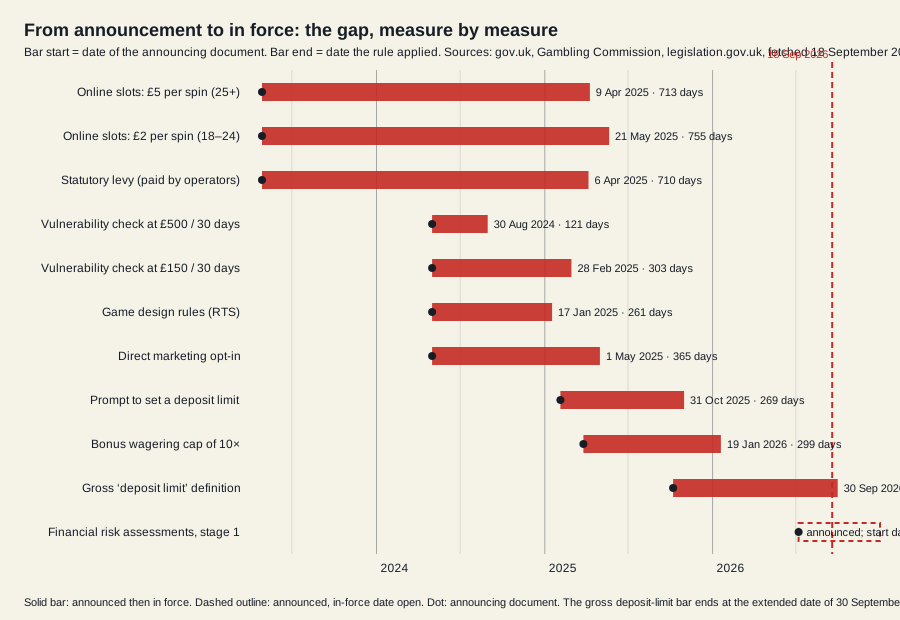
Which Gambling Act Review measures apply to UK players now, and which are still to come
A dated register of Gambling Act Review measures, tracing policy announcements to the rules that took effect and keeping proposals with no confirmed start date separate.
Read Which Gambling Act Review measures apply to UK players now, and which are still to come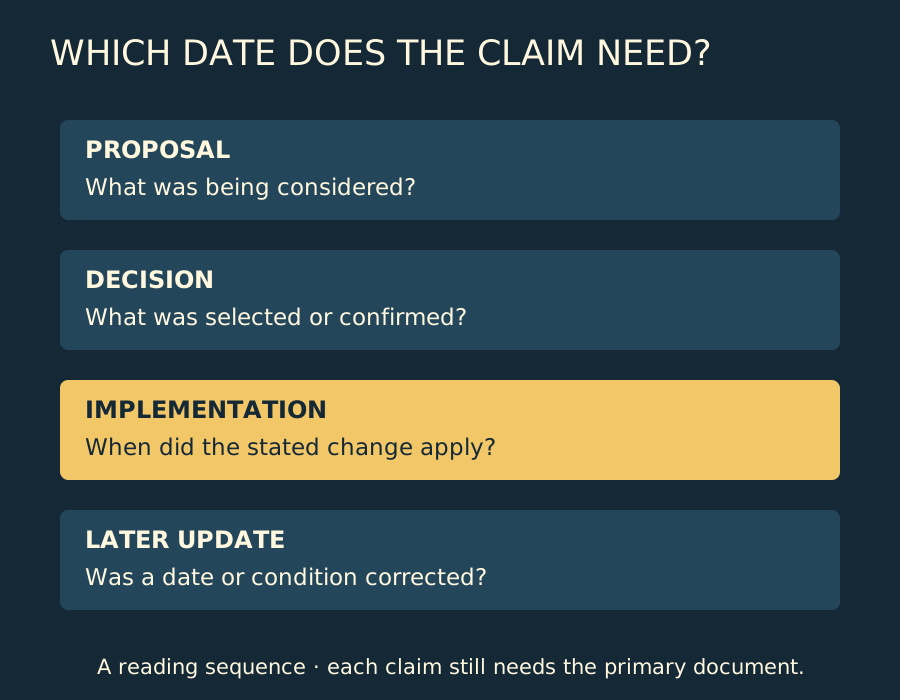
UK online casino regulation changes: how to read the dates and scope
Follow the online slots and bonus-rule timelines to distinguish a consultation, decision, implementation date and later correction.
Read UK online casino regulation changes: how to read the dates and scope
Continue reading
Affordability checks gambling: what changes, for whom, and from when
Register as of 21 September 2026. 'Affordability checks' is not a term in the Licence Conditions and Codes of Practice. The phrase covers two measures with different dates. The financial vulnerability check has been in force since 30 August 2024, at £150 net deposits in a rolling 30 days since 28 February 2025. Financial risk assessments were announced as a staged programme on 7 July 2026, with no Stage 1 start date yet published.
Read Affordability checks gambling: what changes, for whom, and from whenFinancial vulnerability checks and financial risk assessments run on different timetables
The £150 rolling threshold is an existing public-record check. The July 2026 financial-risk decision describes a separate staged programme whose first start date still needs confirmation in the sources reviewed.
Read Financial vulnerability checks and financial risk assessments run on different timetablesThe gambling levy’s 1.1% rate is an operator calculation
The statutory levy changed how gambling-harm funding is collected. Its rate, revenue base, first-year adjustment and later scope correction need to stay attached to the dates.
Read The gambling levy’s 1.1% rate is an operator calculationFind an official casino source
Two dates every regulatory summary needs
Which Gambling Act Review measures apply to UK players now, and which are still to come
Affordability checks gambling: what changes, for whom, and from when
Financial vulnerability checks and financial risk assessments run on different timetables
The gambling levy’s 1.1% rate is an operator calculation
UK online casino regulation changes: how to read the dates and scope