Facts checked Article
Casino regulatory sources
The gambling levy’s 1.1% rate is an operator calculation
The statutory levy changed how gambling-harm funding is collected. Its rate, revenue base, first-year adjustment and later scope correction need to stay attached to the dates.
The liable party is the licence holder
The statutory gambling levy is payable by holders of operating licences under the Gambling Levy Regulations 2025. For a remote casino operating licence, the stated rate is 1.1% of the leviable amount. That is not a rule requiring a player to hand over 1.1% of each deposit or withdrawal.
The distinction matters because the rate is easy to detach from its base. Deposits, stakes, prizes and the amount defined for the levy are different accounting quantities. The regulations and the Commission's calculation guidance supply the relevant basis; a percentage in a headline does not.
This briefing follows the measure's decision, commencement and operational guidance through the documents checked on 19 September 2026. It also records a later correction concerning revenue from customers outside Great Britain. The method is to keep each date beside the kind of event it describes and each figure beside the quantity to which it applies. We have not inspected an operator invoice, measured consumer price changes or verified a collected national total.
Sources: The Gambling Levy Regulations 2025; Statutory Gambling Levy: consolidated guidance.
Separate the decision, the law and the first bill
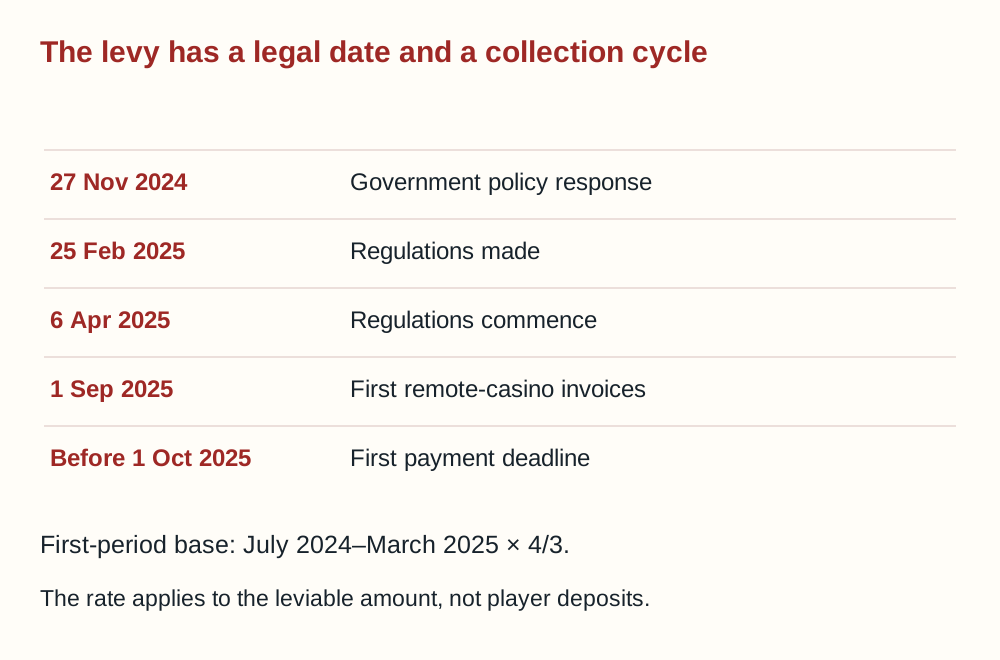
The government published its response to the levy consultation on 27 November 2024. That response set out policy decisions following the consultation. The Gambling Levy Regulations were made on 25 February 2025 and came into force on 6 April 2025. Those dates describe different steps; neither the consultation nor its response was an invoice to a player.
The Commission's guidance explains the subsequent collection cycle. Invoices are made available from 1 September each year, with payment required before 1 October. Its first-year remote-casino example identifies invoices on 1 September 2025 and payment before 1 October 2025. The first collection deadline should not be relabelled as the law's commencement date.
For the ordinary following cycle, an invoice issued on 1 September 2026 uses activity from April 2025 to March 2026, according to the guidance. The year in the invoice date therefore differs from part of the revenue period it describes.
Our figure gives the chronology separate lanes for policy, legal commencement and calculation periods. A date is useful only when the reader can tell which lane it belongs to.
Sources: Government response to the consultation on the structure, distribution and governance of the statutory levy on gambling operators; The Gambling Levy Regulations 2025; Statutory Gambling Levy: consolidated guidance.
Read the revenue base before multiplying
For licences other than lottery operating licences, the Commission describes the calculation using stakes paid to the licence holder, plus other amounts accruing directly in connection with the licensed activity excluding VAT, less amounts deducted for prizes or winnings. Its current guidance frames the relevant calculation around gambling revenues earned from Great Britain customers.
That description is more precise than applying the levy to deposits. Money placed in an account is not necessarily identical to money staked in the levy period, and a stake can be funded by a previously returned prize. The law does not tell a reader to calculate the levy from a bank statement's deposits alone.
The 1.1% rate includes remote casino operating licences, while other licence categories have different rates. This briefing does not turn that category into a universal rate for every form of gambling or every activity of a company holding several licences.
For a published example, identify the licence category, period, relevant amounts and rate. If those inputs are unavailable, leave the operator's liability unknown. Multiplying an industry headline by 1.1% cannot reconstruct an individual invoice without establishing that the headline uses the same base.
Sources: The Gambling Levy Regulations 2025; Statutory Gambling Levy: consolidated guidance.
A transparent calculation using invented amounts
Assume a hypothetical remote casino has £10,000,000 of relevant stakes in an ordinary annual levy period, £9,600,000 deducted for prizes or winnings, and no other qualifying amounts for this example. The assumed leviable amount is £10,000,000 − £9,600,000 = £400,000. At 1.1%, the illustrative levy is £400,000 × 0.011 = £4,400.
Applying 1.1% directly to the £10,000,000 stakes would give £110,000. That is not the calculation just specified because it omits the deduction for prizes. The difference is not a rounding issue; it is a different denominator. Neither result is a charge we observed on a player's account.
The example deliberately excludes other relevant income, multiple licence categories and adjustments. It is an arithmetic illustration based on stated assumptions, not tax or accounting advice for an actual business. The regulations also provide that no levy is payable where the calculated amount is £10 or less; our example is well above that threshold.
The calculation does not establish the percentage a casino returns in any individual session. The aggregate amounts were invented for the levy example and must not be read as a measured RTP or a product specification.
Sources: The Gambling Levy Regulations 2025; Statutory Gambling Levy: consolidated guidance.
The first year needs its own adjustment
The first levy period differs from the ordinary annual cycle. For most licences, including the remote-casino example in the guidance, it uses July 2024 to March 2025 data and a multiplier of one and one-third. Society lottery operating licences have a different first-period treatment; they should not be folded into the same example.
Take a separate invented nine-month leviable amount of £300,000 for a remote casino. At 1.1%, the unadjusted calculation is £3,300. Multiplying that by four-thirds gives £4,400. Equivalently, annualising the assumed £300,000 to £400,000 and then applying 1.1% gives the same answer.
That agreement is a useful arithmetic check, not a statement that the hypothetical business actually earned £400,000 in twelve observed months. An adjustment to a nine-month base and a measured twelve-month result are different records. Do not relabel the annualised figure as revenue directly observed across a full year.
Nor should the first-year multiplier be carried into every later invoice. The Commission describes the following cycle using the previous financial year's data. A comparison of levy bills should first establish whether one includes the transitional adjustment and the other does not.
Sources: The Gambling Levy Regulations 2025; Statutory Gambling Levy: consolidated guidance.
A later guidance correction changes the scope record
The Commission's consolidated guidance says that in September 2025 it issued separate invoices for Great Britain and non-Great Britain leviable activity. It then records a review concluding that the regulations should be interpreted as applying to revenue earned from Great Britain customers, rather than income earned abroad.
The guidance defines a Great Britain customer for this purpose by physical location in Great Britain when using the gambling facilities, regardless of usual residential address. It also addresses gambling-software income linked to facilities offered to those customers. Residence, company location and customer location during use should therefore not be substituted for one another.
The document describes cancellation or refund arrangements for affected invoices and a single-invoice approach for future years. We report that as the Commission's published position, not evidence that a particular operator received a refund. We also do not invent the exact day on which each affected invoice was corrected.
This entry demonstrates why a change register needs room for implementation corrections after commencement. A summary frozen at the original legislation date would miss the later operational interpretation even if it quoted the rate accurately.
Funding allocations are not evidence of outcomes
The government response set out a funding split of 20% for research, 30% for prevention and 50% for treatment. Those are allocations in a policy design. They do not establish how much a particular clinic has received, how quickly someone can obtain support, or what treatment outcomes have occurred.
The Commission describes its role as collecting and administering the levy under government direction. Its guidance also separates levy payments from future voluntary contributions: voluntary payments do not count towards settling the statutory invoice. Describing the system simply as optional donations would therefore miss the change in the obligation.
There are several distinct financial records an editor might encounter: an expected annual yield, an invoice total, cash actually collected, money allocated to a programme and money spent by a recipient. A figure from one stage should not be presented as evidence of another. An outcome claim needs further evidence beyond the movement of funds.
This briefing includes no forecast presented as a confirmed receipt and no claim that the levy has already reduced gambling harm. Evaluating that would need appropriate published evidence and a method, not just the fact that the regulations commenced.
Sources: Government response to the consultation on the structure, distribution and governance of the statutory levy on gambling operators; Statutory Gambling Levy: consolidated guidance; Statutory Levy.
What an online-casino reader can conclude
The documents establish an operator levy, its rate for remote casino licences, its calculation framework and a timetable. They do not establish that a particular casino has passed the cost to customers, changed its games or complied with every other gambling requirement. Those would be separate claims requiring evidence about the business and the relevant period.
If an account displays a charge described as a levy, the existence of these regulations alone is not an explanation of that line item. Ask the business to identify the contractual basis and explain the calculation. This article makes no finding about a hypothetical charge and does not turn the operator's statutory obligation into an automatic player fee.
For future updates, check the legal instrument and the current consolidated guidance together. Record the publication or update date, the effective date where one is given, the period being measured, the customer scope and the licence category. Preserve any correction rather than silently overwriting the older claim.
That produces a change record a reader can audit: who owes the levy, on what amount, for which period, and under which dated document. It also leaves the unanswered questions visible instead of treating one percentage as the whole policy.
Sources: The Gambling Levy Regulations 2025; Statutory Gambling Levy: consolidated guidance.
Questions answered
When does a rule announced today actually apply?
Check the operative source rather than the announcement alone. For this levy, the policy response was published on 27 November 2024, the regulations were made on 25 February 2025, and commencement was 6 April 2025.
How is the statutory gambling levy calculated?
For the simplified remote-casino example, apply 1.1% to the relevant leviable amount, not directly to player deposits. The first-year calculation also had a separate four-thirds adjustment to its nine-month base.
When must the statutory levy be paid?
The Commission’s guidance says invoices are available from 1 September with full payment required before 1 October. That collection timetable is separate from the law’s 6 April 2025 commencement.
Does the gambling levy apply to non-GB revenue?
The Commission’s later guidance records an interpretation limiting the levy to revenue earned from Great Britain customers, with a defined physical-location test and a specific explanation for software income. Do not rely on the original separate-invoice approach as the current position.
Source directory
Continue reading
Affordability checks gambling: what changes, for whom, and from when
Register as of 21 September 2026. 'Affordability checks' is not a term in the Licence Conditions and Codes of Practice. The phrase covers two measures with different dates. The financial vulnerability check has been in force since 30 August 2024, at £150 net deposits in a rolling 30 days since 28 February 2025. Financial risk assessments were announced as a staged programme on 7 July 2026, with no Stage 1 start date yet published.
Read Affordability checks gambling: what changes, for whom, and from when
Financial vulnerability checks and financial risk assessments run on different timetables
The £150 rolling threshold is an existing public-record check. The July 2026 financial-risk decision describes a separate staged programme whose first start date still needs confirmation in the sources reviewed.
Read Financial vulnerability checks and financial risk assessments run on different timetables
Which Gambling Act Review measures apply to UK players now, and which are still to come
A dated register of Gambling Act Review measures, tracing policy announcements to the rules that took effect and keeping proposals with no confirmed start date separate.
Read Which Gambling Act Review measures apply to UK players now, and which are still to come
Jurisdiction before the headline: what changes, for whom, and from when
A casino rule change is not a worldwide rule change. Section 33 of the Gambling Act 2005 states the position for Great Britain, and a licence issued elsewhere does not carry into it.
Read Jurisdiction before the headline: what changes, for whom, and from when
Two dates every regulatory summary needs
The day a change is announced and the day it takes effect can be months apart.
Read Two dates every regulatory summary needs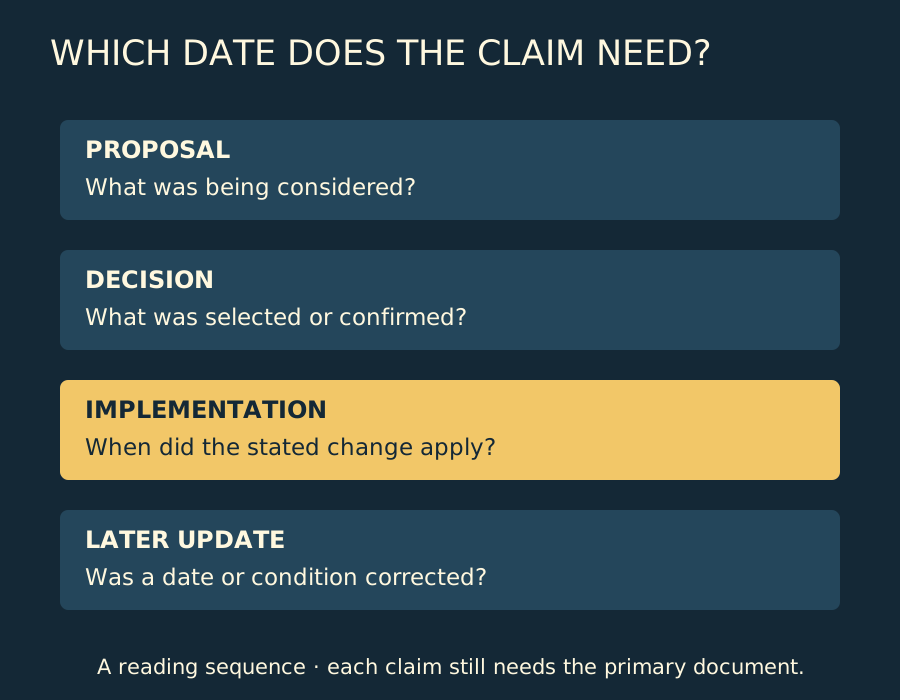
UK online casino regulation changes: how to read the dates and scope
Follow the online slots and bonus-rule timelines to distinguish a consultation, decision, implementation date and later correction.
Read UK online casino regulation changes: how to read the dates and scope
Continue reading
Affordability checks gambling: what changes, for whom, and from when
Register as of 21 September 2026. 'Affordability checks' is not a term in the Licence Conditions and Codes of Practice. The phrase covers two measures with different dates. The financial vulnerability check has been in force since 30 August 2024, at £150 net deposits in a rolling 30 days since 28 February 2025. Financial risk assessments were announced as a staged programme on 7 July 2026, with no Stage 1 start date yet published.
Read Affordability checks gambling: what changes, for whom, and from whenFinancial vulnerability checks and financial risk assessments run on different timetables
The £150 rolling threshold is an existing public-record check. The July 2026 financial-risk decision describes a separate staged programme whose first start date still needs confirmation in the sources reviewed.
Read Financial vulnerability checks and financial risk assessments run on different timetablesWhich Gambling Act Review measures apply to UK players now, and which are still to come
A dated register of Gambling Act Review measures, tracing policy announcements to the rules that took effect and keeping proposals with no confirmed start date separate.
Read Which Gambling Act Review measures apply to UK players now, and which are still to comeFind an official casino source
Jurisdiction before the headline: what changes, for whom, and from when
Two dates every regulatory summary needs
Which Gambling Act Review measures apply to UK players now, and which are still to come
Affordability checks gambling: what changes, for whom, and from when
Financial vulnerability checks and financial risk assessments run on different timetables
UK online casino regulation changes: how to read the dates and scope